Last updated November 18, 2026

Free written scope consultation - allowances, timeline, and change-order rules on paper before a single trade is scheduled
Driveway & Pavers Maintenance Checklist for El Monte Homeowners
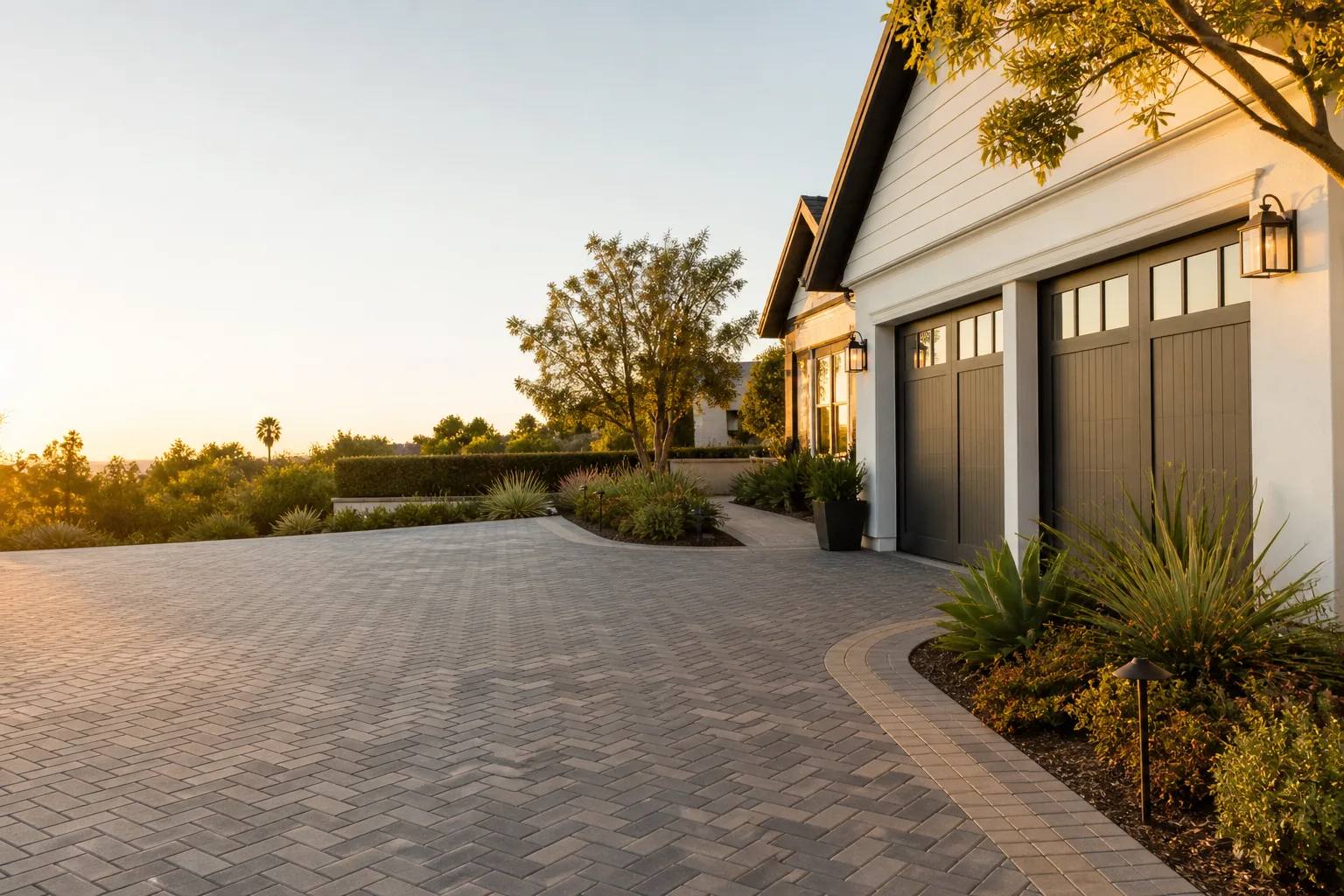
The driveway failure we see most often in El Monte doesn’t start with a crack. It starts with missing sand. A dry summer pulls moisture out of the joints and contracts the ground under the pavers, then the first real winter rain sends water straight through those open joints into the base. Most homeowners never notice the gap until a paver rocks underfoot or a corner chips. This checklist is built around that exact cycle: hot, dry summers, an occasional cold snap, and rain that arrives all at once. We’ll walk through sand timing, efflorescence, what cracking means, sealer windows, and where DIY ends and a contractor begins.
Quick Answer
In El Monte, paver driveways need re-sanding after the first significant rain of the season rather than on a fixed calendar date, annual cleaning before the UV peak, and a careful eye on joint width and base movement instead of only surface appearance. Concrete driveways need crack and seal work done before the winter rains, not after. Most surface maintenance is homeowner-friendly; anything involving a rocking paver, a sunken section, or a failing base needs a professional. Our technicians have up to 13 years of experience reading exactly these patterns across the San Gabriel Valley.
Styles & brands we work with
- Kitchen remodeling
- Bathroom remodeling
- Home additions & ADU
- Roofing
- Windows & doors
- Driveway & pavers
- Fence
Table of Contents
- Why El Monte Driveways Fail Differently Than the Rest of Southern California
- When to Re-Sand Paver Joints in El Monte
- Efflorescence vs. Dirt: What You’re Actually Looking At
- Crack Patterns: Base Failure or Surface Wear?
- Annual Sealer Timing and El Monte’s UV Peak
- What You Can DIY vs. What Voids a Workmanship Warranty
- The Concrete Driveway Maintenance Checklist
- A Four-Season Maintenance Calendar for El Monte
Why El Monte Driveways Fail Differently Than the Rest of Southern California
El Monte sits in the San Gabriel Valley, and that location matters more than most homeowners realize. The valley traps heat in summer, pushes daytime surface temperatures well above the air temperature, and then drops into cold overnight lows during winter months. That combination moves the ground under your driveway more than a coastline address would. A paver driveway in El Monte expands during a hot August and contracts through the cool nights, working the joint sand loose from both directions.
The rain pattern compounds it. When rain does come, it tends to arrive in concentrated storms rather than a slow soak. That means water hits dry, shrunken soil and open joints all at once. The base layer absorbs what it can, and the rest runs through the paver field looking for a weak spot. Where the base has settled even slightly, the water pools, softens the bedding sand, and starts the rocking that eventually becomes a trip hazard or a chipped corner.
The neighborhoods where we see this most are the older residential blocks around downtown El Monte and the streets near the Rio Hondo, where mature trees, older concrete, and dense clay soils all put extra load on a driveway. Newer residential pockets in the northern part of the city tend to have different soil prep, but they face the same heat cycle.
Three local factors drive almost every maintenance decision on an El Monte driveway:
- Summer heat above 95°F that pulls moisture from joints, sealers, and the base itself
- Cool winter nights with occasional cold snaps that move the ground and open joints further
- Concentrated winter rain that finds every open joint in a single storm
If you’ve been managing your driveway on a generic “once a year, maybe in spring” schedule, that schedule is likely wrong for El Monte. The rest of this guide replaces it with something tied to the actual season pattern here. And if you’re comparing a new installation against repairing what you have, our driveway & pavers work covers both, from base prep up.
When to Re-Sand Paver Joints in El Monte
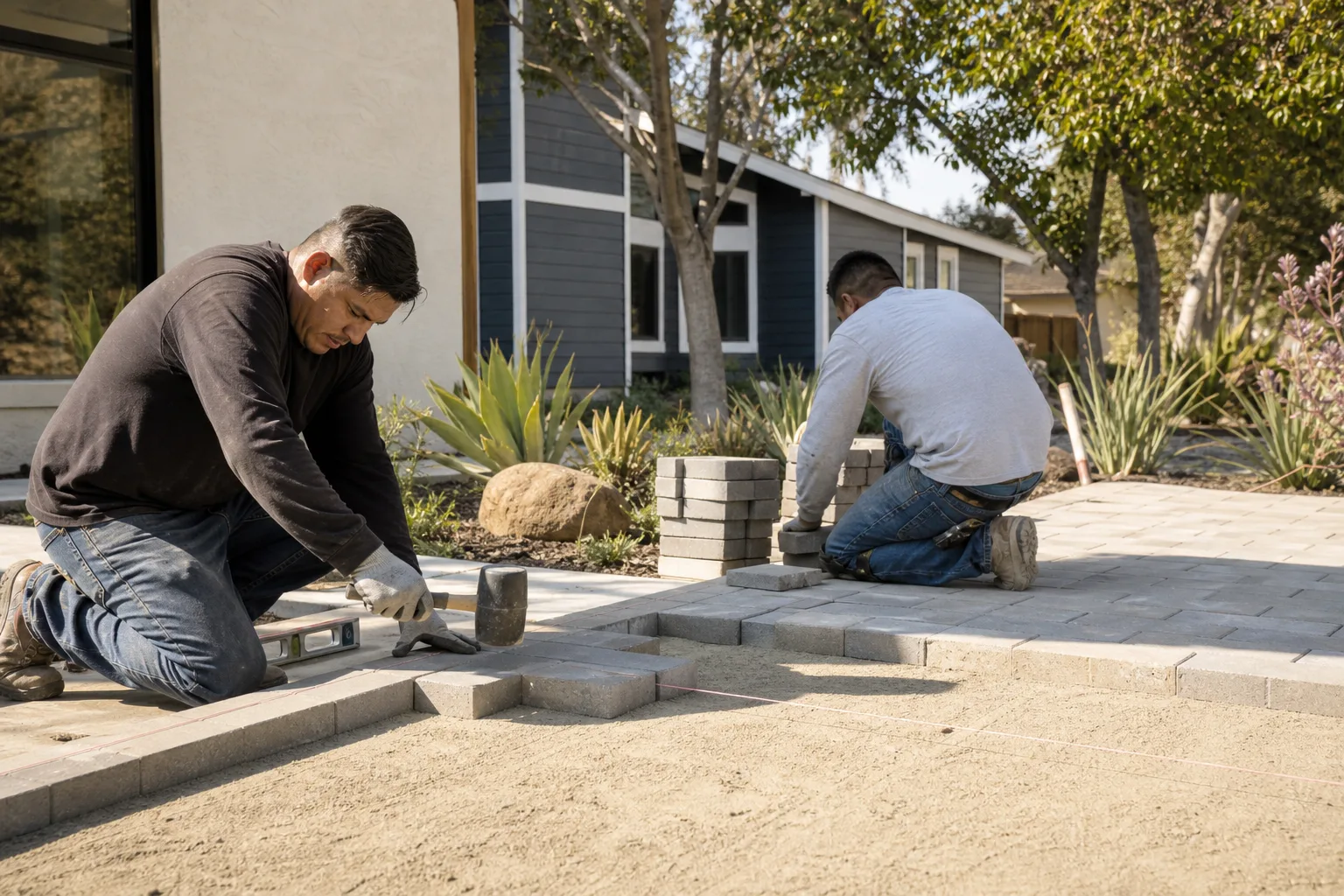
Re-sand your paver joints after the first significant rain of the season, not on a calendar date. In El Monte, that usually means sometime between late fall and early winter, once a real storm has moved through and the joints have settled into their post-summer position. Sanding before that rain wastes material, because the joints haven’t finished shrinking and the first storm will simply wash the new sand deeper or away. Sanding too late means water has already been finding a path into the base for weeks.
Here’s how the timing actually works in this climate:
- Watch for the first storm. The first significant rain after a dry summer is your signal. It compresses and redistributes the existing sand and reveals exactly which joints need attention.
- Wait for the surface to dry. Give it a day or two of dry weather after the rain. Wet joints won’t accept sand properly, and you want to see the true joint depth.
- Check joint depth across the field. Walk the driveway and look at joints. If you can see more than a shallow groove in the main drive lane or where tires sit, those are your priorities.
- Apply joint sand from the far edge. Work from the back of the driveway toward the street so you don’t walk over freshly sanded areas. Spread, sweep into the joints, and repeat until the joints are full and level with the paver surface.
- Plan a mid-season check. After the second major storm, look again. Rain sometimes reveals a joint you missed, or a low spot where water sits.
One important note: which sand you use matters. Polymeric sand sets up harder and holds longer, but it needs the joints to be dry and it needs to cure without rain, which is hard to predict in winter. Standard joint sand is more forgiving and easier to top-off later. Which one is right depends on the paver brand and the joint width; manufacturers like Belgard and Unilock publish guidance for their own product lines. When in doubt, check the material spec or ask before you buy a bag.
If a section of joints empties out again within a few weeks of re-sanding, that’s not a sand problem. It’s a sign of base movement, and it’s the point where you should stop re-sanding and start diagnosing. We’ll get to that below.
Efflorescence vs. Dirt: What You’re Actually Looking At
Efflorescence is a white, powdery haze that appears on concrete pavers when water travels through the material and carries dissolved salts to the surface. Dirt is on top of the paver. Efflorescence is coming out of it. The two look similar from a standing height, but the test is simple: dirt wipes away with water, effort wipes away with water and comes back a few weeks later.
In El Monte, efflorescence typically shows up in two windows. First, after the winter rains, when water moves through the pavers and dries out slowly in the cooler air. Second, during a hot dry stretch, when any moisture still in the slab cycles to the surface and evaporates quickly, leaving the salt behind. We see it most on newer installations and on driveways near the edges where materials meet the soil or turf.
How to tell the difference:
- Efflorescence is usually white or grayish-white, chalky, and appears in patches or along joints. It reappears after cleaning and won’t scrub off with plain water alone.
- Dirt is brown, black, or gray, settles in low areas and joints, and washes away easily. It doesn’t return within a couple of weeks.
- Staining (oil, rust, tire marks) is darker and localized near the source. It doesn’t lift with a standard cleaner.
Cleaning matters here because the wrong product does damage. Acid-based cleaners will remove efflorescence quickly, but on many manufactured pavers they can etch the surface or strip a factory sealer, which is exactly the sort of thing that can void a manufacturer’s product warranty. Belgard, Unilock, and Techo-Bloc each publish a recommended cleaning approach for their lines, and the safest path is to use a manufacturer-approved efflorescence cleaner rather than a hardware-store acid. Always test on a small hidden paver first, especially on colored or textured products.
If efflorescence keeps coming back after proper cleaning, the underlying cause is moisture still moving through the paver, which usually points back to a base or drainage issue rather than a cleaning problem.
Crack Patterns: Base Failure or Surface Wear?
Not every crack is an emergency, and not every crack is cosmetic. In El Monte, the difference usually comes down to where the crack is and how it’s changing. A single hairline crack on the surface of one paver that hasn’t widened in a year is surface wear. A crack that runs across multiple pavers in a line, or a crack at the edge that keeps opening, is base failure until proven otherwise.
Use this to sort what you’re seeing:
- Surface wear (monitor): a hairline, no vertical movement, no width change over a full season, single paver, often near a joint or edge where the paver was cut.
- Base failure (fix now): a crack line that crosses several pavers in the same direction, visible joint widening or narrowing, a paver that rocks when stepped on, a dip or hollow sound when tapped, or the driveway holding water after rain.
- Structural issue (call a professional): a sunken section larger than a single paver, a section that has dropped away from the rest of the surface, or cracks that repeat after being repaired.
The reason a multi-paver line crack is different here is the base beneath it. El Monte’s clay-heavy soils expand and contract with moisture, and the heat cycle drives a lot of that movement. If a base was under-compacted during installation or if a section settled unevenly, a hot summer and wet winter will open a line crack. That doesn’t get fixed by filling the crack. The paver field in that section has to come up, the base re-compacted or rebuilt, and the pavers re-set.
If you see a surface crack on pavers from a name brand, the first step isn’t repair: it’s documentation. Take a photo with something for scale, note where it is, and note if it’s changing. A manufacturer like Tremron or Techo-Bloc may want to see the evidence before standing behind a product issue, and a clear photo record makes that conversation straightforward.
Annual Sealer Timing and El Monte’s UV Peak
Seal a paver driveway in El Monte in the cooler months before the UV peak, ideally late winter or early spring, so the sealer has cured before summer sun hits it hard. Sealer is a thin protective film, and UV exposure breaks it down. If you seal in June or July, the sealer is getting cooked from day one. If you seal in the cooler window, it bonds, cures fully, and gets its full working life before the strongest sun arrives.
The “before the UV peak” rule has a caveat: don’t seal immediately after rain. The pavers and the base need to be dry. A sealer applied to damp pavers can trap moisture and go cloudy, and that haze can be difficult to remove. In El Monte, that usually means sealing in late January through March, once the main rain pattern has passed and you have a dry window with a couple of mild nights coming up.
What the sealer is actually doing for you:
- Reducing joint sand loss by locking the surface of the sand in place
- Slowing UV color fade on colored and textured pavers
- Making stains easier to clean up before they get into the paver
- Helping resist the moisture cycle that drives efflorescence
What it does not do: it won’t fix a rocking paver, it won’t rebuild a soft base, and it won’t replace missing joint sand. Seal a healthy driveway. Don’t seal one that needs base work first, because you’ll be sealing a problem you have to tear up anyway.
Also consider the product. Manufacturer lines from Belgard and Unilock have recommended sealer types, and the wrong sealer can discolor the surface or void a warranty. Solvent-based sealers in particular need care on some products. A test patch on a hidden area is always the right first move.
For homeowners who want the whole exterior to work as one system rather than a set of piecemeal fixes, this is the same logic we apply to exterior work across the property, from the driveway edge to the fence line.
What You Can DIY vs. What Voids a Workmanship Warranty
Most paver maintenance in El Monte is genuinely DIY-friendly. The line is this: anything on the surface is yours, and anything below the surface belongs to a professional, because working the base yourself is exactly what ends a workmanship warranty.
Reasonable DIY:
- Sweeping, hosing, and spot-cleaning the surface
- Re-sanding joints on a healthy field where pavers are flat and stable
- Applying manufacturer-approved efflorescence cleaner to a test patch first
- Pulling weeds from joints and edges before they seed
- Photographing changes in cracks, joints, or surface color for your records
- Re-sealing with the correct product once the surface is staged and dry
What voids a workmanship warranty and should go to a professional:
- Lifting and re-setting pavers, even a small number, unless the installer approves it first
- Adding base material or sand under a section that has settled
- Cutting pavers yourself to fill a gap or a missing edge
- Applying a sealer or acid cleaner the manufacturer doesn’t recommend
- Pressure-washing at high pressure directly into joints, which can blow sand out
The reason a workmanship warranty doesn’t cover a homeowner’s base work is straightforward: once you’ve lifted pavers, the installer can no longer verify the base condition, the bedding, or the joint prep. If the same section fails again, the cause is unclear. Some manufacturer warranties also require professional installation and approved cleaning products, so the wrong cleaner can be a warranty issue even without a paver moving.
If a paver does rock or a section does settle, call the installer or a professional first. A quick photo and a conversation now is cheaper than discovering later that the fix falls outside coverage. On bigger exterior projects where the driveway ties into walls, steps, or a new fence installation, it’s worth having the same team handle the transitions so warranty responsibilities stay with one party.
The Concrete Driveway Maintenance Checklist
Pavers get the attention, but plenty of El Monte driveways are poured concrete, and concrete in this climate has its own maintenance pattern. The heat and dry-cycle cause concrete to shrink slightly and open cracks that were fine before. Winter rain then fills them. Small cracks handled in the fall stay small; cracks ignored through a rainy winter get bigger, and the water reaching the subbase is what eventually causes a slab to lift or fail.
A simple year-round checklist for a concrete driveway:
- Walk and mark. Every few months, walk the slab, note every crack with a pencil line so you can see if it opens.
- Seal narrow cracks before the rainy season. If a crack is hairline, a proper concrete crack filler will do. It needs a clean, dry surface.
- Route larger cracks to a professional. If a crack is wider than a pencil, is running along the edge, or is next to a settled slab, that’s a base or structural question.
- Check the expansion joints. The felt or fiber strips between concrete sections should stay flexible. If they’ve cracked or gone hard, they’re no longer doing their job.
- Look for spalling and scaling. Small flaking or chipping on the surface is typically a finishing or moisture issue, not a sign of structural failure.
- Watch for water pooling. Standing water after rain points to a low spot or poor drainage, both of which need attention before the next storm.
El Monte’s combination of hot summers and cool winters makes the fall crack check the most important step on this list. That’s when cracks are still visible and dry, and the repair cures before the rain arrives. If you find subsidence, structural cracking, or a slab that has visibly dropped, that work belongs with a professional installed concrete and hardscape team rather than a caulk-and-patch approach.
Most homeowner concrete jobs start with a stabilizer crack and end with a structural question. Get the assessment first, so you spend money on the right fix.
A Four-Season Maintenance Calendar for El Monte
Here is the calendar we’d actually recommend for a paver or concrete driveway in El Monte. It’s built around the local climate, not a generic national schedule.
Late Summer (before the rains): Do the crack check and the joint inspection while everything is dry. On concrete, seal any narrow cracks. On pavers, note any joint gaps so you know what to expect after the first rain. Check for settled areas and photograph anything worrying.
Early Winter (after the first significant rain): Re-sand the paver joints. Address any efflorescence with an approved cleaner. Check the expansion joints on concrete and clear any debris from edge drains or the garage apron.
Mid to Late Winter: Do the annual sealing in a dry window. Inspect for base movement now, since rain will expose any weak spot. Watch for efflorescence return and treat it as a moisture indicator.
Spring (before the UV peak): Clean the driveway surface, check joint sand after the last storm, and note any color or surface changes on the pavers. Address the small surface cracks before summer stress hits.
Summer: Light maintenance only. Watch the joint sand, keep the surface clean, and don’t seal in this window. If pavers start to rock, call for a look before the fall rains.
A large share of driveway problems in El Monte would never happen if a homeowner worked one seasonal check and one post-rain re-sand into the year. It’s a two-session job annually for most driveways, and both sessions are simple.
If your drive connects to a larger exterior plan, or you’re already looking at bigger changes like an ADU or a patio extension, our home additions & ADU team works alongside the hardscape work so the driveway, drainage, and structure all line up.
Common Mistakes to Avoid
- Re-sanding on a calendar date instead of after rain. In El Monte’s climate, sand put down in July is mostly gone before it matters. Wait until the joints have settled after the first significant winter rain, then sand.
- Sealing in summer to “protect” the pavers. Sealing into the UV peak means the sealer degrades fastest and gives the least protection. Save the seal for the cooler, dry window before the sun returns.
- Using acid cleaner on efflorescence without checking the manufacturer’s recommendation. Acid can etch some concrete pavers and can strip factory finish. Belgard, Unilock, and other manufacturers publish approved cleaner lists, and using one is a warranty question, not just a cosmetic one.
- Pressure-washing joints at full blast. High pressure pushes out the joint sand, which is the exact thing you’re trying to protect. Keep the wand moving and keep the pressure moderate on the field.
- Re-filling a multi-paver crack as if it were surface damage. A crack that crosses several pavers in a line usually points to a settled base. Filling it hides the symptom and lets the cause get worse.
- Lifting “just one” paver and re-setting it. Once you lift a paver and reset it without the installer, the workmanship warranty typically no longer covers that section. Call first, even for a small issue.
- Skipping the concrete crack check before winter. Small, dry cracks sealed in the fall stay small. The same cracks after a wet winter are a much bigger bill.
See the difference
 Before
 After
 Before
 After
 Before
 After
When to Call a Professional
Call a professional the moment the problem moves below the surface. A paver that rocks, a section that has settled, a multi-paver crack line, a hollow sound underfoot, or water that stands after rain are all base-level issues, and no amount of sand, sealer, or cleaner will fix them. The same is true on concrete: a slab that has dropped, an edge crack that keeps reopening, or spalling across a large area needs an inspection before repair.
Get a professional involved before you try a DIY repair that might end a workmanship warranty. A short visit now can save the cost of redoing a section later.
Construction El Monte offers free estimates in El Monte. We work with pavers from Belgard, Unilock, Tremron, and Techo-Bloc, and we handle both new installations and repair work when a base has failed. Our technicians have up to 13 years of experience, and the written estimate sets the final price before work begins. Call (844) 320-2624 to schedule your free estimate. We answer 24/7. Fast dispatch from 7am to 7pm, Sunday through Friday.
Frequently Asked Questions
Re-sand after the first significant rain of the season, which in El Monte typically lands in late fall or early winter, and then plan one check after the second storm. Most driveways need a full re-sand once a year in this climate, not on a fixed calendar date. If joints empty out again within a few weeks, that’s a base issue, not a sand issue. Call (844) 320-2624 for an assessment and a free estimate.
If the white haze reappears after cleaning it with plain water, it’s efflorescence, which is salt coming out of the paver as moisture evaporates. Dirt washes away clean and stays away. Use a manufacturer-approved efflorescence cleaner rather than an acid product, and test on a hidden paver first. If it keeps coming back, the moisture driving it is probably coming from the base or a drainage problem, which we can diagnose with a free estimate. Call (844) 320-2624.
Yes, an annual sealer is the right rhythm in El Monte, ideally in late winter or early spring in a dry window before summer sun hits. Sealing in summer wastes the product because UV degrades it fastest. Don’t seal over missing joint sand or a rocking paver, because you’d be protecting a problem that needs fixing. Call (844) 320-2624 if you want the prep and sealer done in one visit.
A hairline crack in a single paver that hasn’t widened over a full season is surface wear, and it can be monitored. A crack that crosses several pavers in a line, a hollow sound underfoot, or a section that rocks or holds water after rain is base failure and needs repair now. Don’t fill a multi-paver crack with sand or caulk. Call (844) 320-2624 for a free inspection and estimate.
Yes, with a moderate setting and a moving wand. High pressure aimed directly into joints is what causes damage, because it blows out the joint sand that holds the pavers in place. Keep the nozzle moving, avoid concentrating on one joint, and re-sand after the wash if joints look low. If you’d rather have the cleaning and re-sanding done together, call (844) 320-2624 for a free estimate.
Yes, in most cases. Once a homeowner lifts and resets a paver or adds base material, the installer can’t verify the base or bedding, and workmanship coverage on that section typically ends. Always call the installer or a professional first, even for a single rocking paver. Construction El Monte handles warranty-safe repairs and offers free estimates in El Monte, so call (844) 320-2624 before you dig in.
The Bottom Line
El Monte driveways don’t fail from weight. They fail from the far more ordinary cycle of a dry, contracted summer followed by concentrated winter rain. If you remember nothing else from this guide: re-sand after the first significant rain, seal before the UV peak, treat efflorescence as a moisture problem rather than a cosmetic one, and treat any multi-paver crack or rocking section as a base issue until a professional says otherwise. Keep concrete cracks sealed before the rainy season. Handle surface maintenance yourself, and let a professional handle anything below the joints. That combination is the difference between a driveway that lasts decades and one that needs a rebuild in five years.
If you’re looking at paver repair, a replacement, or a fresh installation using Belgard, Unilock, or Techo-Bloc materials, Construction El Monte can help with a free, written estimate. Call (844) 320-2624. We answer 24/7. Fast dispatch from 7am to 7pm, Sunday through Friday.
Written by the team at Construction El Monte.